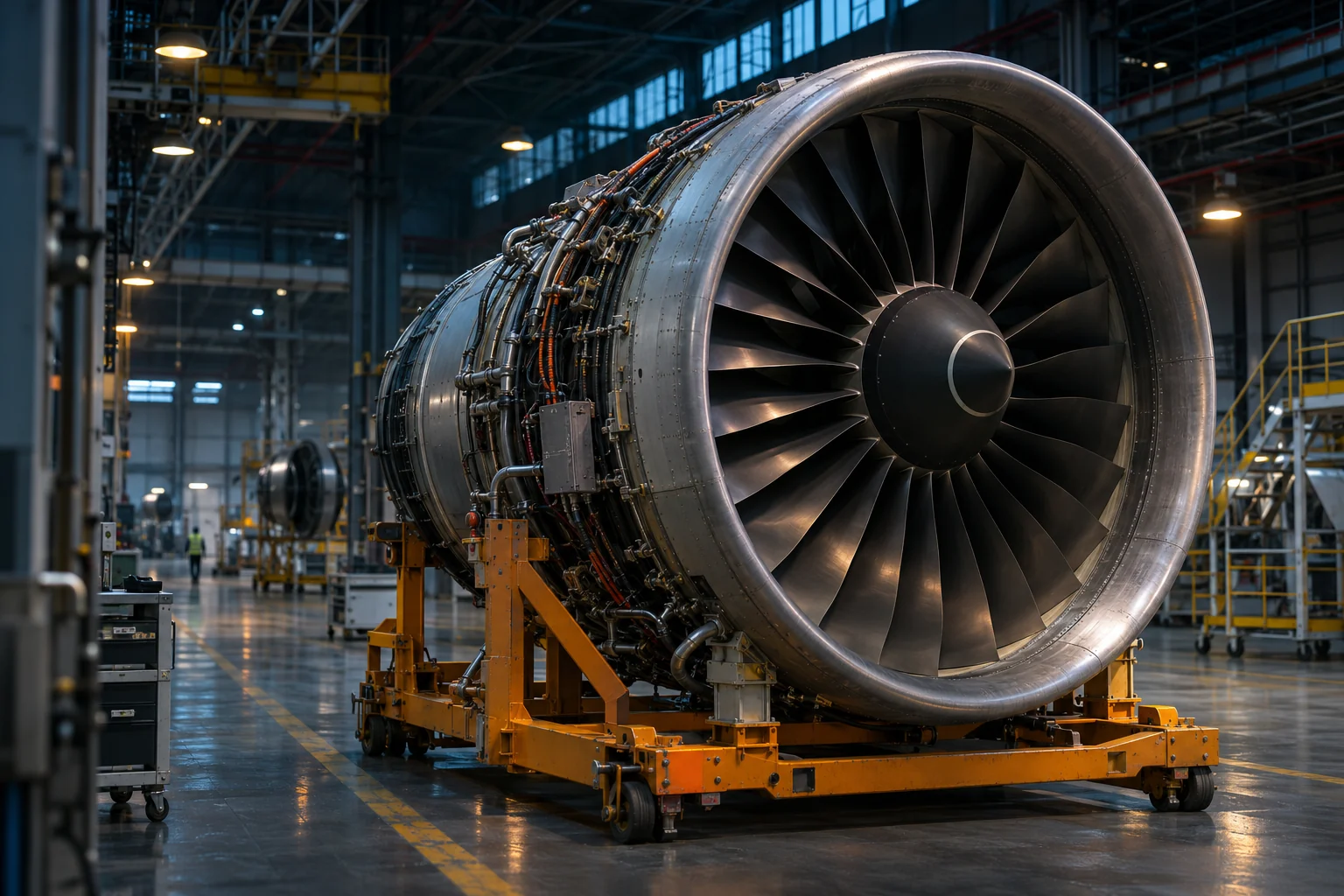
When an aircraft engine needs an overhaul, the maintenance team takes it off the wing, secures it on a stand and sends it to a workshop equipped to service that model.
At the workshop, technicians take the engine apart as needed and inspect the components one by one. They repair the parts they can and replace the ones they need to. Once the engine is back together, they run it on a test stand to make sure it performs as required. Source
One engine, three ways to pay for maintenance
Pay for labour and parts. Each time an engine goes into the workshop, the airline pays for the labour and parts used on that job. Rolls-Royce can bill this way for inspection and repair work outside SelectCare’s coverage. More workshop visits or replacement parts can mean a bigger bill for the airline. Source
Agree a fixed price for each overhaul. With SelectCare, the price of an overhaul is agreed in advance and the airline pays each time one takes place. The airline pays for any additional overhauls. Rolls-Royce covers any cost overruns on work within the agreed scope of an overhaul. Source
Pay by the flying hour for ongoing maintenance cover. With TotalCare, the airline pays a service fee based on the hours the engine actually flies. When the engine needs an overhaul, Rolls-Royce pays for the maintenance covered by the contract. The airline still has to work out how to adjust its flight schedule. Source
The airline knows in advance how much each extra flying hour will add to its service bill. In return for those payments, Rolls-Royce has to be ready to carry out the maintenance it has agreed to. Try keeping the flying hours the same and adding a workshop visit. How do the two bills change?
Bill calculator
What if the engine needs another workshop visit?
Leave the flying time at 4,500 hours. Change the number of workshop visits from one to two and see what happens to the airline’s bill.
In this example, paying per visit costs US$100,000 less.
These figures are illustrative. Both contracts cover the same engine, time period and work. The fixed price is US$800,000 per visit. The hourly fee is US$200 per engine flying hour.
Where Singapore fits in
When an engine is due for maintenance, Rolls-Royce needs a workshop with the right parts and technicians, plus the equipment to test the engine afterwards. The company arranges maintenance in several countries. One of those workshops is in Singapore. Source
In the Loyang industrial estate, near Changi Airport in eastern Singapore, Rolls-Royce and SIA Engineering Company run a joint venture called SAESL. It began operating in 2001, initially working mainly on Singapore Airlines’ Trent engines. Rolls-Royce later chose the workshop as a main overhaul centre for another model, the Trent XWB, which powers the Airbus A350. Source
Different engines need different parts, repair procedures and tests. Working on engines for Singapore Airlines gave SAESL a starting point. Taking on a new model meant making sure its technicians and equipment could handle that work too.
Flights fell sharply. Workshop visits fell much less
Charging by the flying hour poses a problem for Rolls-Royce. When aircraft fly less, there are fewer hours to bill for. Meanwhile, technicians still have to inspect and repair engines already in the workshop. When flights fell sharply in 2020, the company’s figures showed how differently the two moved. Source
| Measure | 2019 | 2020 | Fall |
|---|---|---|---|
| Engine flying hours | 15.3 million | 6.6 million | About 57% |
| Workshop visits | 966 | 831 | About 14% |
Workshop visits include inspections, repairs and overhauls.
Flying hours more than halved, while workshop visits stayed close to nine-tenths of the previous year’s total. The change in maintenance spending also depends on which parts each visit required and what work was done.
Paid when engines fly, called on when they need work
Airlines pay for service by the flying hour and Rolls-Royce pays for the maintenance covered by the contract. The Singapore workshop does some of that work. It repairs and tests the engines it receives before handing them back.
Compare the three maintenance contracts and who pays for what
Sources
- SAESL · Engine disassembly, repairs and testing
- Rolls-Royce · TotalCare pricing and coverage
- Rolls-Royce · SelectCare fixed-price overhauls and separately billed labour and parts
- Rolls-Royce · Global maintenance network
- Land Transport Authority · Location of Loyang industrial estate
Ministry of Trade and Industry · SAESL’s early operations
SIA Engineering Company · The joint venture and engine models
Rolls-Royce · The Trent XWB engine for the Airbus A350 (PDF) - Rolls-Royce · 2020 full-year results, page 12 (PDF)